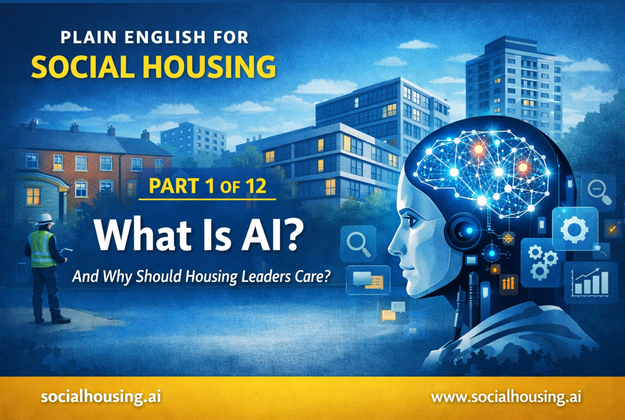
What Is AI (And Why Should Housing Leaders Care?)

Artificial Intelligence is now part of the conversation in social housing.
It appears in supplier demonstrations.
It features in board discussions.
It is referenced in strategy papers.
It is increasingly used in operational systems.
Yet many people across the sector are still unclear about what it actually is.
This series has been created to address that.
Over the next twelve articles, we will explain the most common AI terms in straightforward language, written specifically for housing professionals. The aim is not to turn anyone into a data scientist. It is to build confidence and understanding so that leaders can make informed decisions.
What Is AI?
AI stands for Artificial Intelligence.
In simple terms:
Artificial Intelligence is software designed to perform tasks that normally require human judgement, pattern recognition or decision-support.
Those tasks might include:
- Analysing large volumes of information
- Identifying patterns
- Generating written responses
- Predicting likely outcomes
- Suggesting actions
It is not a physical machine. It is not a robot. It is software that processes information at speed and scale.
A Practical Housing Example
Consider a repairs service with thousands of historic work orders.
Reviewing that data manually would take significant time and resource. AI can analyse the same data in seconds and highlight:
- Repeat visits linked to specific job types
- Contractors with higher follow-on rates
- Emerging damp and mould patterns
- Properties generating disproportionate reactive spend
It does not replace professional judgement. It provides insight more quickly.
The value comes from how housing professionals interpret and act on that insight.
What AI Does Not Do
There are some common misunderstandings.
AI does not:
- Correct poor data quality
- Repair weak processes
- Replace accountable leadership
- Remove the need for professional oversight
If the underlying systems are flawed, technology will not resolve that on its own. In some cases, it may expose those weaknesses more clearly.
Why This Matters for Social Housing
The operating environment is changing.
Regulatory expectations are rising.
Response times are under scrutiny.
Budgets are constrained.
Service demand continues to increase.
AI is being presented as part of the solution.
Without a clear understanding of the terminology, organisations risk either investing without clarity or rejecting tools without properly assessing their value.
Understanding the basics is becoming part of responsible governance.
What This Series Will Cover
Future parts will explain:
- What a Large Language Model is
- The difference between a chatbot and an AI agent
- What “automation” really means
- What predictive analytics involves
- What digital workers are
- The risks boards should understand
- The practical questions leaders should ask suppliers
Each article will focus on clarity and relevance to housing operations.
AI will not transform services on its own.
However, leaders who understand it will be better placed to shape how it is used.
Part 2 will explain what a Large Language Model is and why it sits behind many of the AI tools currently entering the sector.